
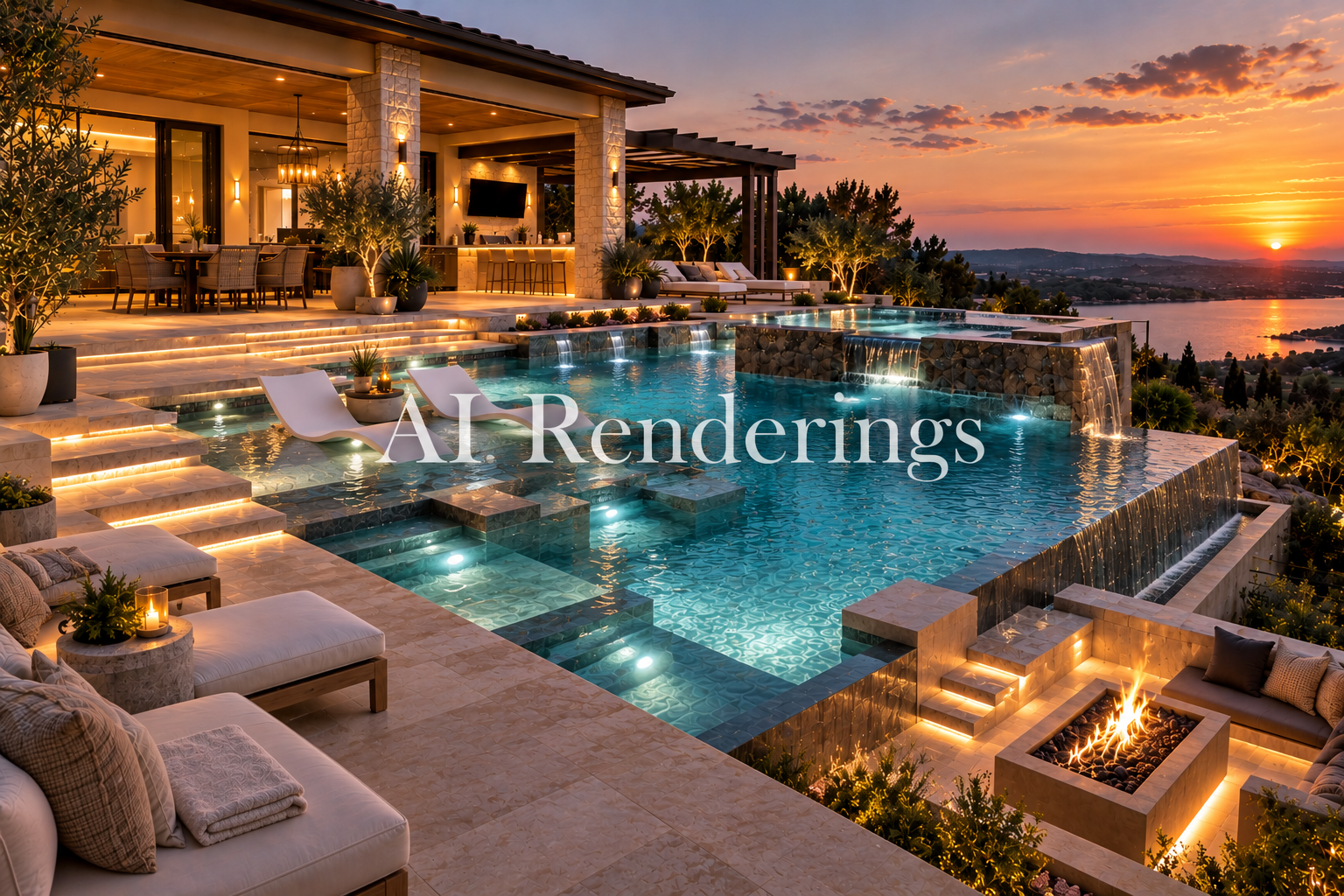
We understand the appeal of AI. Within seconds, you can generate a beautiful room, a dramatic outdoor space, or an entire home concept. It is fast, accessible, and SOMETIMES impressive. But a convincing image can create a false sense of confidence. Looking beautiful on a screen and working in real life are two very different things.
This week we are sharing, “Don’t Settle for an Algorithm!” Read on to be educated on how we feel AI is benefiting and hurting the Design + Build Industry and decided for yourself if you want to use AI for your projects!
Don’t Settle for an Algorithm…
AI generates images from patterns learned from existing work and material. Familiar looks and heavily represented trends will dominate the results, and AI will repeat the familiar styles, materials and arrangements. While AI offers efficiency, its algorithms often lead to generic outcomes. The concern is obvious. A qualified designer brings an individual eye, a point of view, and the judgment to move beyond what is popular at the moment. Imagine a world where every design feels the same—void of the unique touch that only human creativity can bring.
A convincing image does not make AI a designer and your project deserves more than a picture built from patterns. Popular does not mean personal. For some projects, a familiar, trend-driven look may be enough. But if you want something personal—something that reflects your property, your history, and how you actually live—a designer brings far more than a revolving photobook of algorithmic images.
For designers and builders, judgement is developed through years of creating, building, observing and learning what works. It means noticing the character in an old material, knowing when a room needs restraint, and understanding how stone, wood, steel, and glass will realistically feel together when you are standing in the room. Human designers craft with intuition and emotion, qualities that no machine can replicate.
The Ethical Elephant…
There's also the ethical elephant in the room: AI systems use input designs without permission and very often for model training; raising significant concerns about intellectual property. Design drawings, renderings, and project photographs are someone’s creative work. They represent years of experience and hours of decisions—not free material for an AI prompt. A designer’s work represents time, expertise, and creative investment. Paying for those services, or even finding them online, does not give someone permission to upload, alter, reproduce, or repurpose them through an AI service and generate a substitute. Why you ask? Because most AI platforms retain the right to use submitted content to train or improve their models, even when a "private" setting is selected. Not only infringing upon copyrights but also, making changes that discredit the accuracy and quality of our work; and depending on the platform and its terms, uploading work often allows it to be retained or used in ways the designer & builder never authorized.
The same respect we give a photographer’s image should extend to a designer’s work. Changing an image does not erase the person who created it or the rights attached to it. Our company has already joined other design + build firms in updating contracts to address AI use and protect our creative work and rights. We've seen the transformation AI can bring when used as a supportive tool. It streamlines repetitive tasks and provides inspiration, yet the heart of creation beats within human minds.
Is it RIGHT?
Looking right is not the same as being right. AI can generate an attractive space in seconds. But it does not walk your property, understand your family, or bring years of firsthand construction experience to your project. It certainly does not take responsibility when the image you fell in love with cannot be built as shown. A design + build company's work begins with the people, the property, and the purpose of the space. Materials have meaning. Proportions matter. So does knowing when to introduce something unexpected—and when to leave something alone. You are hiring someone to create a space that belongs to you, with decisions grounded in experience.
I have been experimenting with several AI tools and plug-ins in my own workflow. Roughly 70% of the time, I find significant mistakes—errors that could cost a contractor and client substantial money if the output were trusted without professional review. These are not always mistakes you can spot by looking at the image. They involve measurements, scale, clearances, functionality, or changes to the actual design. The most expensive mistakes may look perfectly fine. AI can make an incorrect idea look finished, realistic, and ready to build. That is precisely the problem.
A room can look beautifully proportioned while leaving insufficient clearance. A pool rendering can appear convincing while changing the footprint or elevations. A striking feature may overlook drainage, structural support, equipment access, or how the materials actually connect. With AI you cannot assume measurements, scale, functionality, or construction feasibility have been resolved. In short, a realistic image is not proof of a buildable design, and sometimes having to explain every detail of why the AI image won't work and the domino effect, thereafter, can feel defeating. In construction, our decisions have consequences beyond the presentation. Someone has to price the work, order the materials, coordinate the trades, and build it. Our responsibility continues long after the image earns a compliment. Original & correct design takes more than a prompt.
We use AI!
AI has a place in professional design...
We are not against using AI. We are actively exploring where it can help. Used selectively, and as a supportive tool it can help communicate a direction or polish a presentation developed through professional design work. Those can be valuable uses when the designer maintains control and checks the results, but making a presentation more convincing does not make its contents more accurate. The human review still matters. So do the site measurements, material knowledge, construction experience, and conversations with the client. A designer recognizes when an appealing suggestion does not belong in the project.
For me, a tool earns its place when it helps me communicate and execute my creative ideas while preserving the integrity of my design. You deserve a space that feels personal, functions well, and can be built with confidence. Trust a qualified designer for their creativity, judgment, and ability to connect an idea to the realities of construction. Those are the qualities that protect your investment and make a project personal.
DISCLAIMER: I voice uploaded this information and my thoughts into GPT as I was walking and multitasking, then asked it to type it up for me to post - But did in fact proofread every word and make valuable changes!